


"My blood tests are fine."
It is a sentence we doctors hear often. It is usually said with relief, and understandably so: nobody opens a set of results hoping to find something wrong. But behind it there is usually a far harder question: “So, am I healthy?”
And that is not quite the same question.
A blood test can tell us a great deal about our body, yet it can hardly sum up on a single page something as complex as our health. Still less can it tell us how we will be in ten or twenty years.
What being healthy really means
In The Enigma of Health, the philosopher Hans-Georg Gadamer reflected on an idea I have always found fascinating: health has something invisible about it.
When we are ill, the body demands our attention. Pain takes up space. Breathlessness, toothache or an injury change our plans. When we are healthy, almost the opposite happens: we walk, work, travel, train, make plans. The body simply comes along with us.
Perhaps that is one of the paradoxes of health, as it is with love: we often begin to value it when we start to lose it.
In cardiovascular medicine this matters especially, because some of the changes that will shape our future health can develop over years without causing symptoms. High blood pressure, raised cholesterol, atherosclerosis or diabetes in its early stages cannot be felt.
That is why feeling healthy and being healthy are related, but not identical.
A blood test is a photograph. Our health is a film
Doctors need numbers: they let us measure, compare and decide. The problem appears when we turn them into labels, normal or abnormal, good or bad, because biology is a good deal less tidy than that.
The same LDL cholesterol level can mean very different things depending on age, blood pressure, smoking, diabetes, family history or existing cardiovascular disease.
Our body does not age on the day a number crosses a threshold. It ages along trajectories.
Health is also having margin
Think of two 50-year-olds with reasonably normal blood tests.
One trains regularly, keeps muscle mass, can climb four flights of stairs without stopping and has good cardiorespiratory fitness. The other has spent years working seated, has lost strength, has gained waist and gave up exercise some time ago.
They are the same age and could share many laboratory results. Physiologically, though, they are not in the same place.
This is where an important idea in longevity medicine comes in: functional reserve. Our body has more capacity than an ordinary day requires. That cardiac, pulmonary, muscular and metabolic reserve is what lets us respond when life asks for more: an infection, an operation, an injury, or simply the passing years.
The evidence says the best way to age is by preserving functional capacity. That is why muscle mass matters so much: because it keeps us independent.
The heart does not age alone
Medicine divided itself into specialties because doing so let us understand each system in enormous depth. But our body never accepted that division: the heart lives alongside muscle, kidneys, blood vessels, fat tissue, metabolism, sleep and our habits.
Assessing cardiovascular health therefore means putting pieces together:
- Blood pressure, which remains fundamental.
- The lipid profile, interpreted according to individual risk.
- Advanced markers such as apolipoprotein B (ApoB) or lipoprotein(a), which in certain cases add information.
- Glucose, glycated haemoglobin and kidney function.
- Waist circumference and body composition.
And we can also ask a question no blood test answers: what happens when we ask the body for more? Cardiorespiratory fitness is one of the strongest long-term health indicators we know of. Not because we all have to become athletes, but because our capacity to tolerate effort also speaks of our reserve.
The problem with preventing something that does not exist yet
Here a deeply human difficulty appears: it is far easier to react to something happening today than to change our behaviour to avoid something that may happen in twenty years. Chest pain gets our attention immediately; a mildly raised blood pressure over ten years, far less.
We also adapt to losing capacity little by little. We stop running. Then we avoid the stairs. Later we always take the lift. There is rarely a particular day on which we think: “Today I lost capacity.” We simply reorganise our lives around what we no longer do.
Perhaps one of the least visible tasks of preventive medicine is to make perceptible today what we cannot yet feel. Not to live worrying about illness, but to have time to avoid it.
Personalising does not mean measuring everything
We can now measure an extraordinary number of variables, and we will surely be able to measure many more in the coming years. But being able to measure something does not mean we need to.
A test should answer a question and, above all, have some chance of changing a decision. Personalising medicine means asking better questions.
Then come the tools we know work: physical activity, strength and aerobic training, not smoking, sleeping properly, keeping a healthy body composition, looking after what we eat, and controlling blood pressure, lipids and metabolism. And, when indicated, medication or supplements.
None of this is especially spectacular. What is hard is getting there early and sustaining it across a lifetime.
What it looks like from the emergency department
After many years working in emergency medicine I know the other side of this story well. When someone arrives with chest pain, breathlessness, a symptomatic arrhythmia or a loss of consciousness, we are no longer talking about longevity: we have to diagnose, decide and act fast.
With severe or persistent chest pain, do not wait for a scheduled appointment: seek urgent care.
But after years of seeing illness, you inevitably start to be interested in something else: what happened before that patient came through the door? The years before. The silent signals. The opportunities that existed while there were still no symptoms.
Emergency medicine works when the body raises its voice. Longevity medicine tries to listen while it is still speaking quietly.
To close
So if someone asks me, “My blood tests are fine, does that mean my heart is healthy?”, my first answer is that this is very good news. Now let us look at the rest of the story.
Because a healthy heart is not simply one that is not yet ill. It is one that keeps enough reserve to go on with us, through the life we want to live.
This article is for general information and does not replace an individual medical assessment.
More ETRYUM Insights
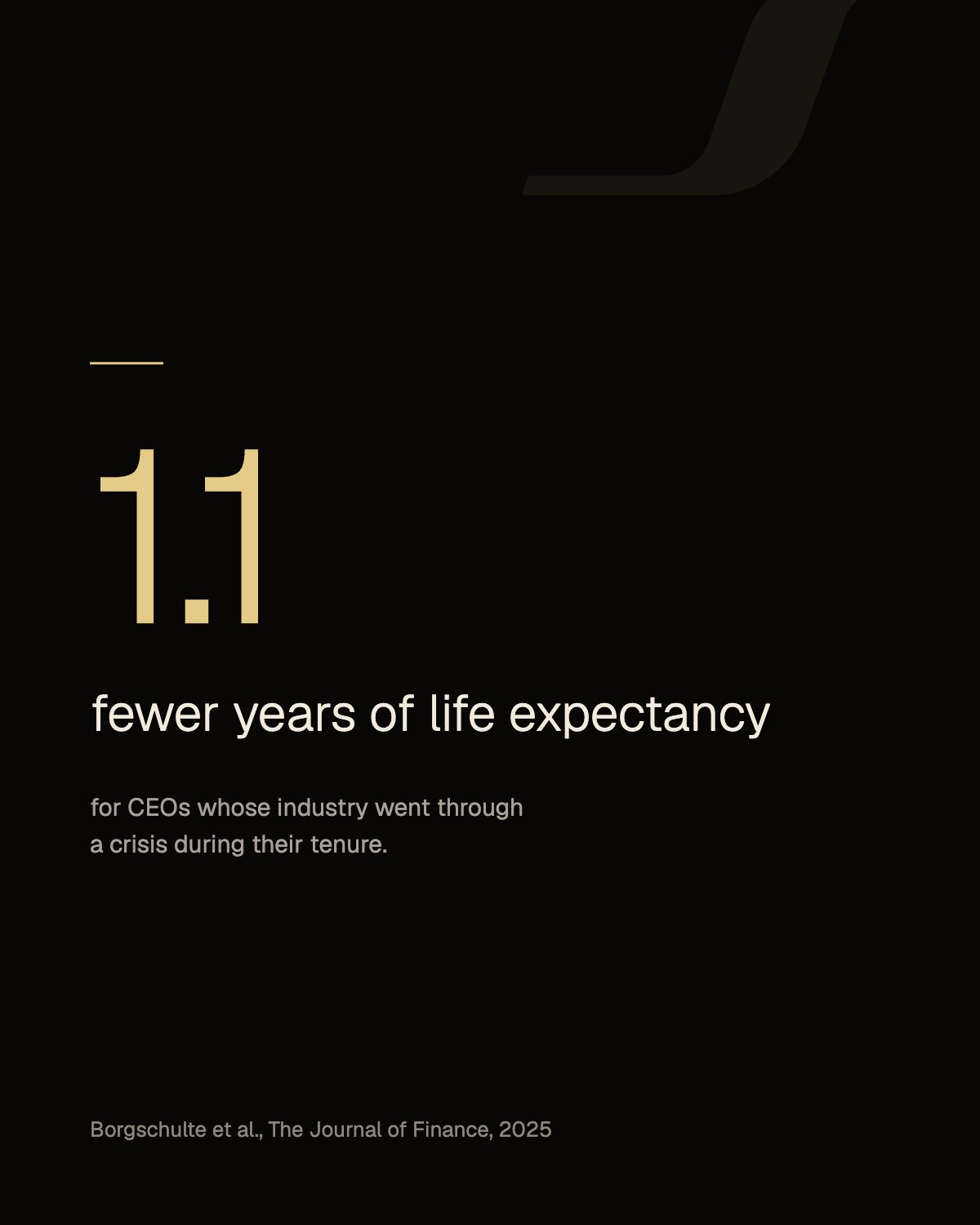
Control: the variable that decides how leading ages you
In 1958, an experiment with monkeys convinced half the world that being in charge makes you ill. Later science showed something else. Dr Emmanuel González explains what we know today about executive stress, the heart and years of life.

Dr Emmanuel González · Executive health 1 OCT 2026 · 7 MIN

From reactive to preventive medicine: why we will be at HUB BienStart
On 15 October, ETRYUM takes part in the first HUB BienStart congress by Mi Empresa es Saludable in Madrid. Héctor Blasco, CEO of ETRYUM, explains what we bring to the panel and why a team’s health cannot wait for sick leave.
Héctor Blasco · Executive health 30 SEP 2026 · 4 MIN