

In 1958, a group of “executive” monkeys convinced the world that making decisions makes you ill.
The psychologist Joseph Brady worked with pairs of monkeys that received electric shocks. One of them, the “executive”, could avoid the shocks for both by pressing a lever in time. The other, the “yoked” monkey, received exactly the same shocks without being able to do anything. The executives developed severe ulcers and several died. The yoked monkeys did not.
The conclusion seemed obvious: responsibility makes you ill. The idea leapt into magazines and doctors’ surgeries, and for decades people spoke of “executive stress syndrome”.
Europe already had its own version. In 1950s Germany, Managerkrankheit, “manager’s disease”, became popular, linked with heart attacks and high blood pressure. Its main advocate built his figures from executives’ obituaries published in the press. By the end of that decade, academic medicine had already dismissed it for lack of empirical basis.
An experiment with a flaw from the start
The monkeys were not assigned at random. Those that learned to use the lever first became the “executives”. And they may have learned first precisely because the shocks affected them more: they were, from the outset, the animals most reactive to stress. Later attempts to reproduce the result did not confirm it either.
The turn: control protects
In 1971, the researcher Jay Weiss returned to the question with rats, this time assigned at random. The result was the opposite: animals that could control the shocks developed fewer ulcers than those that received them without control. Damage increased in one specific case: when the animal had to respond many times without receiving any signal that its response was working.
Four decades later, a Harvard team took the question to real leaders: senior military officers and government officials attending an executive education programme. Compared with people without leadership roles, they had lower cortisol in saliva and less anxiety. And among them, the higher the position, the lower the stress, largely because of a greater sense of control.
In a commentary published alongside the study, the neuroscientist Robert Sapolsky underlined the key point: the position protects to the extent that it brings a sense of control. He also recalled its limit: it is an association study, which cannot show what causes what.
What weighs on a leader’s health is demand without a margin of control.
The other side: when control is lost
If control protects, what happens when it disappears because of something the leader cannot govern?
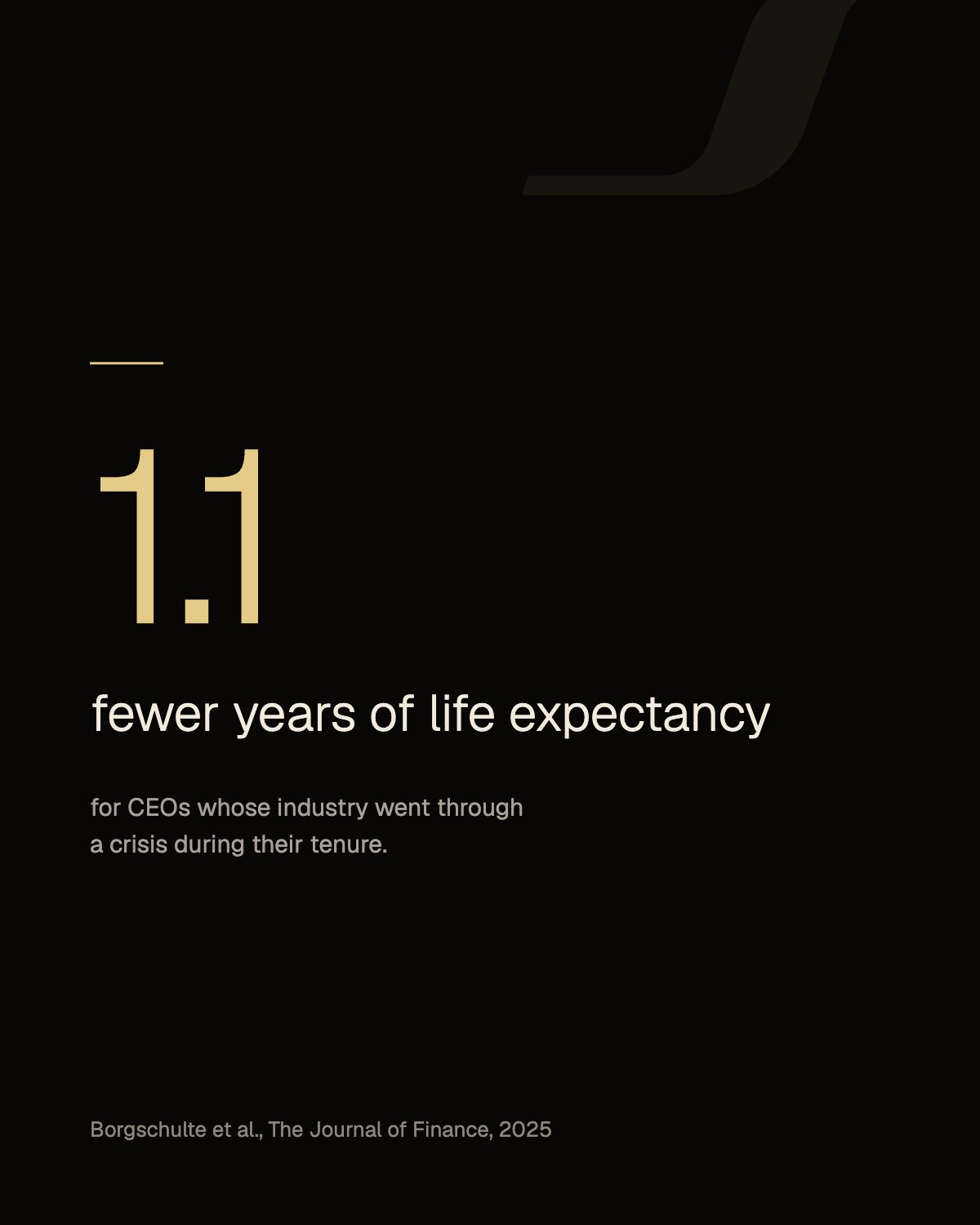
In 2025, The Journal of Finance, a leading journal in financial economics, published a study by Borgschulte, Guenzel, Liu and Malmendier using data on chief executives of large listed US companies since the mid-1970s. Their results:
- Going through a crisis in their own industry during their tenure was associated with a life expectancy 1.1 years shorter.
- When anti-takeover laws shielded the chief executive from market pressure, life expectancy was around 2 years longer.
- Those who lived through an industry crisis during the Great Recession looked about a year older over the following decade, according to an analysis of their photographs with neural networks.
It is worth reading this carefully. “Apparent age” is a research tool, not a clinical test, and the data refer to US chief executives, mostly men, from past decades. But the design compares similar leaders, exposed and not exposed to an external blow, and the message matches what came before: the blow you cannot control does the damage; margin protects.
The time factor
The second variable is easier to measure: hours.
In 2021, the World Health Organization (WHO) and the International Labour Organization (ILO) published the first global analysis of the loss of life and health linked to long working hours. Working 55 hours or more a week, compared with 35–40, is associated with an estimated 35% higher risk of stroke and a 17% higher risk of dying from ischaemic heart disease. In 2016, 745,000 deaths were attributed to this exposure, 29% more than in 2000.
For those who lead, the most revealing figure is the timing. Most of those deaths occurred between the ages of 60 and 79, in people who had worked 55 hours or more between 45 and 74. The bill arrives decades later. For the WHO, long working hours are today the occupational risk factor with the largest burden of disease: around a third of the total attributable to work.
Fifty-five hours means eleven hours a day, five days a week. Or just over nine, six days a week.
The framework: demand, control and recovery
Two classic ideas bring order to all of this.
The first is the demand–control model, proposed by the researcher Robert Karasek in 1979: job strain appears when high demand is combined with low decision latitude. The same load weighs differently depending on how much you can decide about it.
The second is allostatic load, described by the neuroscientist Bruce McEwen. Stress signals protect us in the short term: they mobilise energy and prepare the body to respond. When they are activated chronically, or recovery is missing, wear accumulates in the cardiovascular system, in metabolism and in the immune defences.
Control decides how heavy the load is. Recovery decides whether it accumulates.
And burnout? The WHO classifies it in ICD-11 as an occupational phenomenon, not as a disease. It is defined as chronic workplace stress that has not been successfully managed, and it has three dimensions: exhaustion, mental distance or cynicism towards work, and reduced efficacy. “Executive stress syndrome”, for its part, is a historical concept with no place in current diagnostic classifications.
What to do: first the decision, then the test
The temptation is to ask for a check-up “of everything” or to measure cortisol. The evidence points in another direction. A single cortisol result says little about a leader’s real risk: it varies over the day and, in leaders with control, it tends to be lower, not higher. At ETRYUM we work in the opposite order: first we understand the person, then we decide what to measure.
-
01
Measure the load with judgement
Blood pressure, also outside the consultation room when indicated; lipid profile interpreted according to your overall risk; glucose, waist and body composition; sleep and physical capacity. And two data points that almost never appear in a check-up: how many hours you work and how much margin you have over them.
-
02
Protect recovery
Sleeping enough, moving every day and keeping time free of demands also look after the heart. They deserve a place in the diary, like any important commitment.
-
03
Regain margins of control
Delegating, deciding which matters go through you and protecting uninterrupted blocks of time. It is management, and the available evidence suggests it also counts for health.
-
04
Review over time
A snapshot says little. How blood pressure, waist or fitness change over the years says much more.
Signs that need a consultation without delay: chest pain or tightness on exertion, disproportionate shortness of breath, palpitations with dizziness or a loss of consciousness. With severe chest pain or pain that does not ease, call 112.
An example to make it clearer
Illustrative case
Carlos, 54, managing director
He has been leading a restructuring for two years. He works around 60 hours a week, sleeps six and has stopped training. His annual blood test comes back “fine”; in the consultation room, his blood pressure is 132/84.
We start with his story: hours, sleep, decision latitude and history. We measure his blood pressure outside the consultation room, estimate his overall cardiovascular risk and assess his physical capacity. Then we prioritise: seven hours of sleep, getting back to strength training and reviewing which decisions he can delegate. Three months later, we measure again.
The useful question is a different one: how to keep leading with capacity for the next twenty years.
To finish
Leading can be compatible with good health, and can even be associated with less stress, when the position brings a margin of control. What leaves its mark is the combination of high demand, little control, too many hours and too little recovery. That combination can be measured and, to a large extent, changed.
Know your load. Understand your risk. Protect your recovery. Regain margin.
If you lead a company or sit on a management committee, in Leading under load we explain how we work with executives and organisations.
Sources
- Brady JV, et al. Avoidance behavior and the development of gastroduodenal ulcers. J Exp Anal Behav. 1958;1(1):69–72.
- Hofer HG. Labor, Klinik, Gesellschaft. Stress und die westdeutsche Universitätsmedizin (1950–1980). Zeithistorische Forschungen. 2014;11(3).
- Payne K. The myth of executive stress. Scientific American. 2013.
- Weiss J. Executive Monkey Study. In: Encyclopedia of Animal Cognition and Behavior. Springer; 2017.
- Weiss JM. Effects of coping behavior in different warning signal conditions on stress pathology in rats. J Comp Physiol Psychol. 1971;77(1):1–13.
- Weiss JM. Effects of coping behavior with and without a feedback signal on stress pathology in rats. J Comp Physiol Psychol. 1971;77(1):22–30.
- Sherman GD, et al. Leadership is associated with lower levels of stress. PNAS. 2012;109(44):17903–17907.
- Sapolsky RM. Importance of a sense of control and the physiological benefits of leadership. PNAS. 2012;109(44):17730–17731.
- Borgschulte M, Guenzel M, Liu C, Malmendier U. CEO Stress, Aging, and Death. The Journal of Finance. 2025;80(6):3401–3442.
- WHO/ILO. Long working hours increasing deaths from heart disease and stroke. 2021.
- Pega F, et al. Global, regional, and national burdens of ischemic heart disease and stroke attributable to exposure to long working hours, 2000–2016. Environment International. 2021;154:106595.
- Karasek RA. Job demands, job decision latitude, and mental strain. Administrative Science Quarterly. 1979;24(2):285–308.
- McEwen BS. Protective and damaging effects of stress mediators. N Engl J Med. 1998;338(3):171–179.
- WHO. Burn-out an “occupational phenomenon”: International Classification of Diseases. 2019.
This article is for general information and does not replace an individual medical assessment.
More ETRYUM Insights

From reactive to preventive medicine: why we will be at HUB BienStart
On 15 October, ETRYUM takes part in the first HUB BienStart congress by Mi Empresa es Saludable in Madrid. Héctor Blasco, CEO of ETRYUM, explains what we bring to the panel and why a team’s health cannot wait for sick leave.
Héctor Blasco · Executive health 30 SEP 2026 · 4 MIN

My blood tests are fine: does that mean my heart is healthy?
Being healthy is much more than not being ill, and understanding that difference can change the way we look after our heart.

Dr Emmanuel González · Cardiovascular health 28 SEP 2026 · 6 MIN